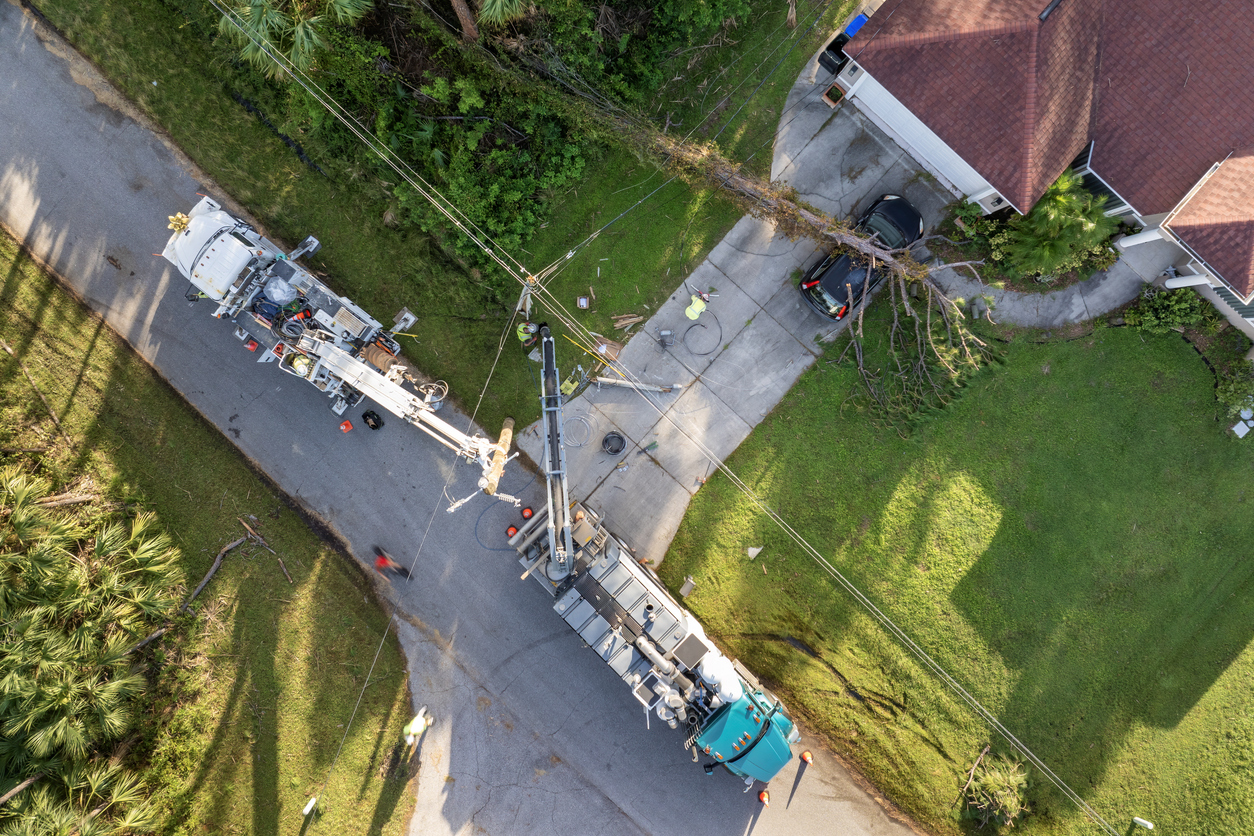

The Short Answer: Most power outages end within a few hours. An equipment failure or a quick thunderstorm is often fixed the same day. Severe weather changes, such as hurricanes, ice storms, and tornadoes, can cause widespread damage that leaves homes dark for several days, and rural areas often wait the longest. How long an outage lasts depends on what caused it, how much of the power grid was damaged, and where your home sits in the utility’s repair order. Backup power sized to the outages your area actually gets is what keeps a long wait from turning into spoiled food, a hot house, or a medical emergency.
Nobody gets a countdown clock when the lights go out. You flip a circuit breaker, check your phone, and start guessing how long the wait will be. That guess decides what you do next with the food in your freezer and the rest of your day.
This guide explains what drives outage duration, why some neighborhoods get power back before others, what starts to go wrong at home as the hours add up, and how to pick backup power that fits the outages you are most likely to face.

What Controls the Length of an Outage
Three things decide how long you wait. The first is the cause. The second is how much damage there is, since one blown fuse is a quick fix while dozens of snapped poles take days. The third is location, because crews start where they can help the most people at once.
The table below is a rough guide. Every storm is different, so treat these as typical patterns rather than promises.
| What Caused the Outage | What Usually Happens | Likely Wait |
| Equipment failure or a blown transformer | A single piece of electrical equipment fails, and a crew replaces it | Minutes to a few hours |
| Thunderstorms and high winds | Limbs fall on overhead lines, and damage is scattered across an area | A few hours, sometimes overnight |
| Winter storms and ice | Ice builds on lines and trees until they snap, often across a wide region | One to several days |
| Tornadoes | Intense, concentrated damage that may require rebuilding poles and lines | Several days in the hardest-hit areas |
| Hurricanes and tropical storms | Wind, flooding, and fallen trees across entire regions at once | Several days or longer |
What the Outage Numbers Show
Federal outage data shows how much severe weather affects the time families spend without power. According to the U.S. Energy Information Administration, interruptions that are not caused by major events average about two hours per year for a typical customer. Major events are a different story. They accounted for nearly nine hours of lost power per customer in 2024, compared with an average of nearly four hours per year over the previous decade. Major events such as Hurricanes Beryl, Helene, and Milton accounted for 80% of the hours Americans spent without electricity that year.
Most everyday outages come and go quickly. Severe weather events are what cause the extended outages people remember, and those storms are a regular part of life in the Southeast.
Why Your Street May Be the Last One Back On

After a big storm, restoration efforts follow a set order. Georgia Power, for example, restores vital community services first, including hospitals, emergency services, and water treatment stations. Next come the repairs that bring back the largest number of customers in the least time. Smaller distribution lines and individual neighborhood connections come last.
If your home sits on a short line at the end of a rural road, utility crews may drive past it for days while they work on repairs that serve thousands of people. A damaged transmission line or substation has to be fixed before the smaller lines it feeds can be reenergized. Crews also need to assess the damage before the utility company can post an estimated restoration time, so early estimates often change.
Get Real Outage Information Instead of Guessing
Most utilities offer tools that take some of the guessing out of the wait.
- Outage map: Shows where outages are, how many customers are affected, and often an estimated restoration time once crews have assessed the damage.
- Outage alert sign-up: Georgia Power, for one, lets customers sign up for outage alerts by text message and adjust their notification preferences.
- App or online reporting: Report your outage so the utility knows your home is affected, even if the map already shows your area.
- Downed lines: Stay away from any fallen power line and call your utility or 911 right away.
What Goes Wrong as the Hours Add Up
A short outage is an inconvenience. A long one starts costing money and, for some households, puts health at risk.

According to FoodSafety.gov, a refrigerator keeps food safe for up to 4 hours during a power outage. A full freezer holds its temperature for about 48 hours, or about 24 hours if it is half full, as long as the freezer doors stay closed.
- Keep doors shut: Every opening lets cold air escape and shortens that window.
- Use an appliance thermometer: Refrigerated food should stay at 40°F or below, and frozen food at 0°F or below.
- Check before refreezing: Food that still has ice crystals or is at 40°F or below can be refrozen, though quality may drop.
- Toss what is unsafe: Throw out perishable food like meat, poultry, fish, eggs, and leftovers after 4 hours without power. When in doubt, throw it out.
Medical Equipment
For households that rely on an oxygen concentrator, CPAP machine, or other medical device, outage duration matters most of all. The FDA recommends telling your electric company and fire department that you have a device that needs power. Also check with the manufacturer about running it on batteries or a generator. A battery backup may cover a few hours, but it will not carry medical equipment through a multi-day outage.
Comfort, Water, and Electronic Devices
Air conditioners, heat pumps, and well pumps all stop when the power does, which can make a Southeast summer or a winter cold snap dangerous for older family members and young children. Sump pumps go quiet right when storms push water toward the house. When electric service returns, the sudden power surge can damage computers and other electronic devices, so many homeowners unplug sensitive items until the power holds steady.
Match Your Backup Power to the Outages You Expect
The right backup depends on how long you realistically need to cover. If you have been through a multi-day outage before, plan for the next one to be just as long.
| Backup Option | What It Covers | How Long It Lasts |
| Battery backup or power station | Phones, a router, lights, and small medical devices | A few hours, depending on battery size |
| Portable generator | A refrigerator, a few lights, fans, and plug-in devices | As long as you keep refueling it by hand |
| Home standby generator | The whole house, including HVAC and well pumps | Days on natural gas, or as long as your propane supply holds |
A portable generator can bridge a short outage, but someone has to start it, refuel it, and run cords. It also has to stay outside to avoid carbon monoxide poisoning. The CDC advises using generators and other gas-powered equipment at least 20 feet from doors, windows, and vents, and installing a battery-operated carbon monoxide detector in your home.
A home standby generator is built for extended outages. It connects through an automatic transfer switch, starts on its own when the grid fails, and runs on natural gas or propane, so there are no fuel cans to refill during a storm. For a closer look at fuel and runtime, see our guide to how long a generator can run during a power outage.
Keep Your Home Running With Anderson Power Services
How long do power outages last? Usually a few hours, but the ones that matter most can stretch for days. Knowing what drives outage duration helps you plan, and dependable backup power means you never have to watch the outage map to know when life gets back to normal.
Anderson Power Services has been keeping the power on since 1995. As a veteran-led, family-based company, we serve homeowners and businesses across Georgia, South Carolina, South Alabama, and Florida. As an authorized Generac dealer, we sell and install Generac home standby generators, along with Generac automatic transfer switches, propane tanks, and portable generators. Our factory-trained technicians service Generac and other major brands, and the MobileLink app lets you check on your generator from anywhere.
Every project starts with a free on-site or virtual consultation, followed by professional installation and a Peace of Mind Service Plan with scheduled inspections, system maintenance, and 24/7/365 remote monitoring. Financing is available through Synchrony, and our 4.9-star Google rating across more than 1,000 reviews reflects the work we put into keeping reliable power in Southeast homes. Call 706-348-1501 or schedule your free consultation today.
Get a Consultation
Virtual or in-person, we will help you determine the best backup power solutions for your needs.