An automatic transfer switch detects when utility power is lost, safely starts your standby generator, and restores power to your home automatically. When utility power returns, it switches your home back and shuts the generator down.
The switch sits at your service entrance, between the utility feed and your main panel, monitoring your primary power source around the clock. When that feed fails or sags to a low voltage, it disconnects from the grid and connects your alternate power source. Most homes use an open transition switch, which breaks the utility connection before making the generator connection so the two never touch. That’s a code requirement, and it’s what keeps generator power from backfeeding onto utility lines where crews are working. Larger jobs sometimes use a closed transition or motorized change-over switch that briefly overlaps both sources for a seamless transfer.
A transfer switch ties into your service entrance and has to pass local inspection, so it is licensed electrical work. Anderson Power handles the whole thing with our technicians and a licensed electrician. Most residential switch installations are straightforward, and we’ll walk you through the expected schedule during your free on-site consultation.
We check your panel, main breaker, service size, and where the switch can mount, then recommend a model.
We pull the permits your county or city requires and schedule the inspection.
We mount the enclosure, land the service conductors, run the control wiring to the generator, and make the connections.
We simulate a utility failure, watch the transfer happen, confirm the return to utility power, and show you how the unit behaves.
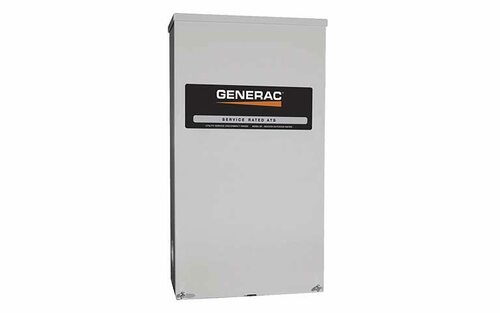
A transfer switch spends nearly all of its life doing nothing, which is exactly why it needs attention. Contacts oxidize, control boards drift, and a switch that has not moved in two years is a switch nobody has proven works. Most systems run a weekly or biweekly exercise cycle, and that cycle is worth listening for. If the generator runs but the house never transfers, the transfer switch may require inspection.
During scheduled service, our technicians inspect and exercise the switch, check the contacts and control wiring, verify voltage sensing and the transfer and retransfer delays, and confirm the unit responds to a real loss of utility power. Service plans with 24/7 remote monitoring watch the system between visits and flag faults, often before you notice. A power outage is a poor time to discover a switch has failed, and emergency power only counts if it arrives, so we keep your system in prime shape and ready when the lights go out.
A generator is not a cart-and-checkout purchase. Sizing the unit to your loads, matching the transfer switch, and getting it wired to code are decisions that determine whether your power actually holds during an outage, and they are hard to get right from a product page. As an authorized Generac dealer, we carry the units in stock, and our experienced team can help you select the right transfer switch for your system.
The support does not stop once you own it. Our licensed electricians handle the transfer switch wiring to power your house circuits, and our technicians take care of the oil, fuel, and battery maintenance that keeps your generator running through every outage. From the first consultation to years of maintenance down the road, you get one team that knows your system inside and out.
It depends on your existing service. A service-rated switch contains the main disconnect and takes the place of your main breaker, which suits new installs and panel replacements. A non-service-rated switch goes downstream of a main disconnect you already have and are keeping. During your consultation, our team determines which transfer switch is appropriate for your electrical service.
A Smart Switch manages load in addition to transferring it. It prioritizes your critical load and sheds high-draw items such as air conditioning when the generator is near capacity, then restores them as demand falls. The practical benefit is that a smaller generator can cover more of the house, which often lowers the total cost of the system.
Match the switch to your electrical service, not the generator. A home with 200 amp service needs a 200 amp switch, and a home with 100 amp service needs a 100 amp switch. You can read your service size off the main breaker in your panel, and we confirm it on site before ordering anything.
Usually, yes. The switch has to be compatible with the generator’s control system and rated for your service. We also install switches on generators we did not sell. Bring us the model number, and we will tell you what works.
It is worth considering if your area sees frequent outages or unstable utility power. Restoration is when spikes tend to hit, and a surge device at the service entrance protects everything downstream. Homes with a lot of electronics, HVAC control boards, or medical equipment tend to see the value most.
The switch waits a short delay to confirm the outage is real rather than a momentary flicker, then starts the generator and transfers the load, typically within seconds of the engine reaching speed. Sensitive electronics may still need an uninterruptible power supply on the equipment itself to ride through that gap, but lights, HVAC, refrigeration, and pumps come back on their own.
Yes, and it gets overlooked. Contacts, control wiring, voltage sensing, and transfer delays all need periodic inspection, and the switch should be exercised so the mechanism moves. Our maintenance visits cover the switch alongside the generator, and service plan customers get 24/7 remote monitoring on top of that.
Three-phase buildings need a three-phase switch matched to the service voltage, such as 120/208 or 277/480. Larger commercial and industrial sites sometimes use more than one switch to separate the critical load from general loads, so the generator carries what matters first. We size and coordinate that as part of a commercial consultation.
Book a free on-site consultation, virtual or in-person, and we will match the right transfer switch to your home or business.
© 2026 Anderson Power Services. All rights reserved. | Sitemap